
So you wanna elevate your soup game? Let me show you how!
In the same manner that salt, herbs, rice and beans are essential to any kitchen, stocks and broths live in that same realm of importance. In this post, I’m going to give you some tips and tricks on how to make them and store them. I’ll also include links to recipes that use stocks and broths! They are wonderful to have on hand and even more wonderful to make from scratch. I love watching the gorgeous colors blend together to create magic.
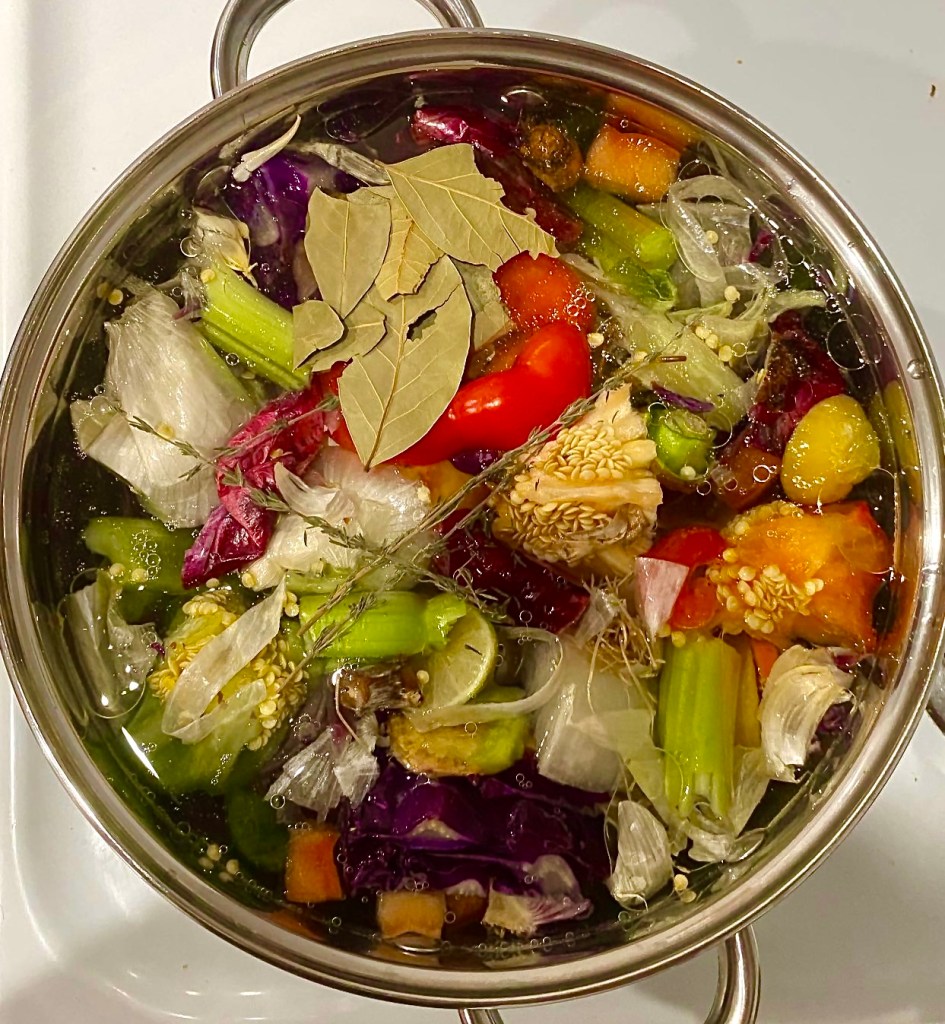
Save those veggie scraps, y’all!
Stock vs. Broth
Let’s just dive right in, shall we? The first bit of information I’m going to offer is the difference between a stock and a broth. A stock is the target of the equation, whereas a broth is the value. What I mean by that is usually a stock wouldn’t be considered a finished product, though on the other hand a broth could be a finished product, depending on your end goal. Stocks can be used to create or enhance sauces, to add more liquid to a recipe, or to thicken or thin out the sauce in a recipe. There are a multitude of uses for stock but the main purpose is for soups, sauces and gravy’s. Broths on the contrary are more of a finished product. Think of an au jus for a delicious steak sandwich or the consomé used to dip your birria tacos in. Broth is usually what comes from your stock in the instance of making a soup or allowing the juices from your beef tri tip to drip into a heat-safe bowl as it cooks, this results in that beautifully flavored, well marinated juice that comes from the process of cooking. So, now that we know the difference between the two, let’s talk about some of my favorite methods for making stocks.
Let’s start with stocks,
no not the fortune 500…
The reason we’re going to focus on stocks for now is because we know that broths are a result of stocks, so my goal is to teach you how to get the most out of your stocks with flavor essentials you may already have in your kitchen. Let’s start with a mirepoix. What is a mirepoix you may ask? Well, particularly in French cooking, a mirepoix is the base of most flavor. You have your 50% onions, 25% celery and 25% carrot. This combination creates a robust flavor that includes 3 of your 5 flavor elements; sweetness from the carrot, bitterness from the celery and sourness from the onion. This will give your stock the essential flavor components when starting out. There are quite a few different kinds of stock that you can make that will be complimented by your mirepoix, the easiest being your standard vegetable stock. What I do to make my basic vegetable stock is get my mirepoix ready. To do this, I start by shaving my carrot, peeling my onion and cutting all three veggies in half (no need for tiny, intricate cuts). I then add the vegetables to a pot filled about 85% of the way with water and a pinch to a pinch and a half of salt. Once that is done, bring it up to a boil and let it reduce once, then let it simmer for a couple of hours. BOOM, veg stock!!!
Tip: SAVE YOUR VEGGIE SCRAPS!
One of the biggest tips I have for folks trying to make a homemade veggie stock is to SAVE YOUR VEGETABLE SCRAPS! Every time I cut off all the vegetable scraps, such as the unsavory white bits and tops you cut off your bell pepper, the shaved carrot skin, the root of the onions, the leaves of the celery, any bits and bobs of your vegetables you choose not to cook with, I save for my vegetable stock. Now, I do this because I do not like to waste any part of the vegetable, but I also understand that there is a significant difference in taste when using something that has been sitting in the freezer for a month or two, to using fresh vegetables that I bought that day at the grocery store or farmers market. I call these leftover bits of vegetables my “veg bags” and usually use these to make a quick stock. Something that I will be using all of THAT day. For a longer-lasting stock, I would suggest using fresher ingredients, like our recipe above! Now when it comes to measurements for making a stock, my best tip would be to follow your heart. Listen to what the ancestors are telling you in terms of how much of this or that you should add, but a general rule of thumb, for when you can’t hear the ancestors would be to rely back on your 50% onions, 25% carrot, and 25% celery. Its a pretty baseline flavor combination that you cannot go wrong with. And you can always substitute out those particular vegetables with vegetables that have the same tastes but with different flavors. This is why I like to utilize my “veg bags”. They’re usually a mixture of all the recent vegetable scraps I’d accumulated over that month (frozen, of course). Once I fill a quart-sized sandwich bag with vegetables, I add those to a 5qt stockpot, with 4qt of water, add some salt, some dry herbs and let it simmer for a couple of hours, then strain. Some veggie scraps I refuse to add to my stock bags would be lemon, lime, potato skin, garlic skin and onion skin. I know in the photo above, some of those ingredients are included, but I’ve tested this recipe enough times to know what to save and what to throw out. The image above is for aesthetic purposes.
How To: Measure with your Heart
To make this recipe more personal to you, measurements for stock are based completely on preference and stock quantity. Please keep in mind, the measurements listed above (1 qt:4qt ratio, veg.:water) are based on my own personal preference and ballpark measurements, as I use a little technique called, “measuring with your heart”. The more water you add, the more muted your flavors will be (keep that in mind). You can choose to use more onions in your stock to give it more acidity or more carrots for sweetness, or garlic for a bit of an umami flavor or in my case for my most recent 24 hour chicken stock, I added two serrano peppers to add some spice to my stock. Measuring with your heart is simple, add what you think will taste good.
Incorporating Meat
My recommendation for including meat into your stocks would be to roast it first. You’ll get the most out of the flavor of the meat by doing this. With stocks that include meat, the general rule is the longer that you allow it to simmer, the more rich in flavor your stock becomes. This is due to the flavors having the opportunity to be extracted further, essentially infusing everything together. As mentioned above, I recently ran an experiment where I made a chicken stock and allowed it to simmer for a full 24 hours. This is not necessarily essential when creating your stocks, but it was a fun little experiment to see exactly how much I could extract from all of my ingredients. The stock came out incredibly rich, deep in color and distinct in flavor. I would definitely recommend this if you have the time, but 3-8 hours would suffice. Happy Eating!
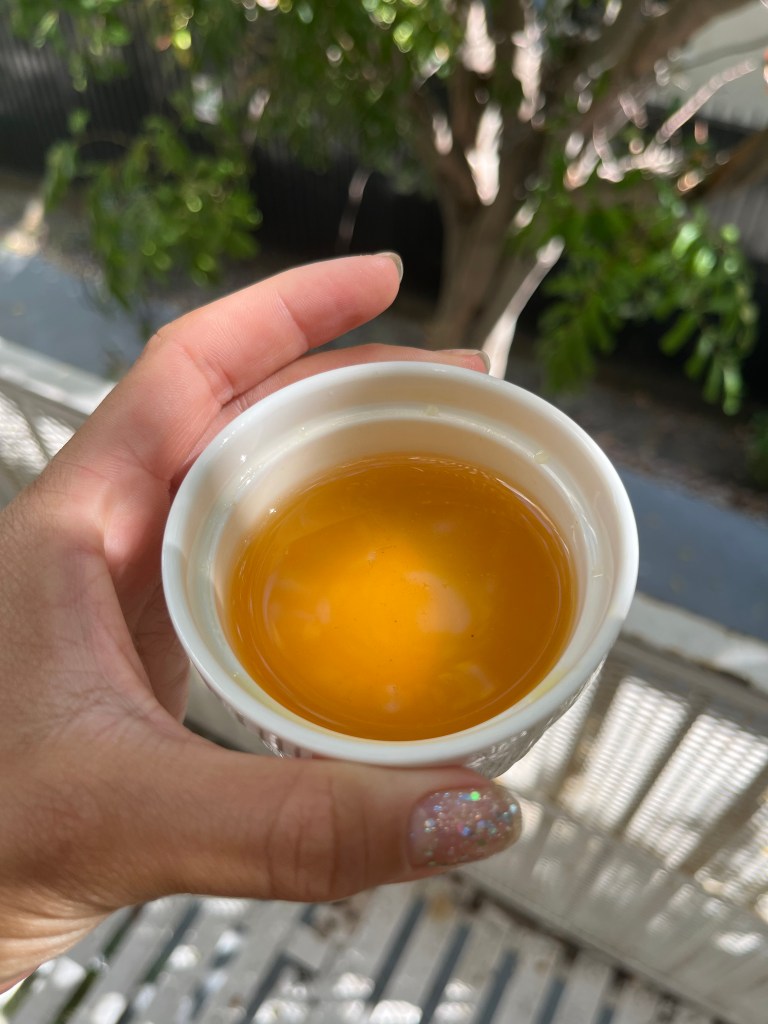
That flavor was out of this world!
 Raaw.Data